
ONO - KONGO / MERCY 12"


ONO - KONGO / MERCY 12"
One-sided Limited Edition 12" LP.
Limited to 100 copies. Pressed at New Orleans Pressing Plant.
Mastered by Andrew Weathers
Photo by David Magdziarz
Art by travis
Layout and Design by Dustin Bowen
P Michael - samplers, drum machine, bass, synthesizer Rebecca Pavlatos - vocals, keys Connor Tomaka - samplers, synthesizer, electronics Ben Karas - drums, percussion Ben Billington - drums, percussion Dawei Wang - guitar Shannon Rose Riley - saxophone, vocals Jordan Reyes - vocals, eurorack synth travis - vocals
The Chicago “Avant-Industrial Gospel Band” formed 40 years ago when punk was starting to get weird and the weirdos were starting punk bands. Over the years ONO faded from the public light but never stopped practicing or finding new shapes for their noise-laden, Afro-Futurist vision to inhabit – a one syllable word spoken with reverence in the Chicago underground. Re-emerging in the mid-teens with several highly regarded records on Moniker Records and a new cast of members pulled from the disparate streams of Chicago experimental music, ONO resurfaced as a triumphant force – leaving audiences completely shook by their high concept, confrontational and often tear-inducing live shows.
ONO was started by travis and P. Michael Grego, enigmatic artists worthy of serious D.C. punk style retrospectives and documentaries. “KONGO” is a skeletal, dirge-filled meditation on one the most sickening acts of genocide enacted on humans and its extensions into modern capitalism and racism, American style. “Mercy” extends ONO’s gospel roots to its most traditional and most deconstructed. Guitars and percussion tear holes into metal while travis’s voice is personified by an authoritative, galloping cadence that marshals disjointed ragtime piano, sheets of noise, throbbing, sub-basement beats felt in the solar plexus and vocal accompaniment by Shannon Rose Riley, Jordan Reyes, and Chicago rapper Malci.
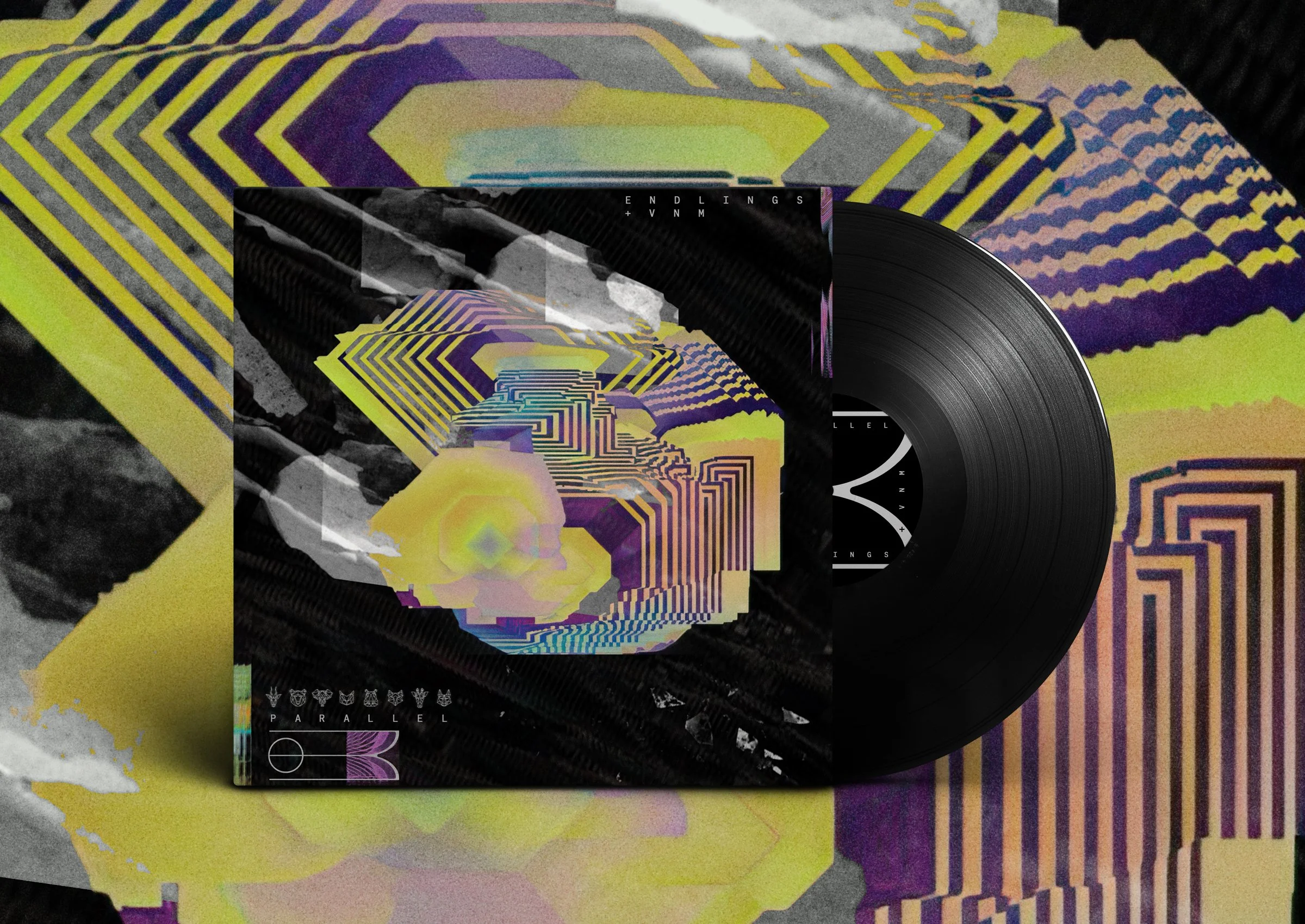
The seeds that germinated between Endlings - a long-running musical collaboration between John Dieterich and Pulitzer Prize winner Raven Chacon - and the Vancouver New Music Circle extends back the Summer and Fall of 2020 and has resulted not only in an album of new work but a fully interactive online instrument presented as a website. More than a website, the project is described as a “shared folder, many folders, an anonymous process, a translation device, a score, a text, a sound, more sounds, words ,many scores ,a multiplier, an exercise in collaboration, a bridge, a mixer, an index, a list, room with rooms in it, a journey or a trip, an album to be.” The creation of the album and the website, "took place on the internet,on many screens, between email threads, in Albuquerque,and on the unceded territories of the xʷməθkʷəy̓əm, Sḵwx̱wú7mesh, səl̓ílwətaʔɬ q̓ic̓əy̓, q̓ʷɑ:n̓ƛ̓ən̓ and Semiahma First Nations.”
This album is a tangible and resonating trace of the creative work and interactions that have been developing and growing among all the artists involved in Vancouver New Music's PARALLEL 03 over a few months of collective work, dialogues, creations, discoveries and exchange in the Summer and Fall of 2020. In its labyrinthine nature the magic PARALLEL 03 website further complements and reveals the richness and powerful interconnections of this ongoing process. The album features the work of Parmela Attariwala, Adrian Avendaño, John Brennan, Elisa Ferrari, Marina Hasselberg, Alanna Ho, Steve Chow and Joel Schuman.
As an album, PARALLEL 03 is nurtured by many things: abstraction, analogy, beauty, brainstorming, intuition, tension, divergent thinking, questions, improvisation, noise, anxiety, diversity, magical thinking, playfulness, ambiguity, serendipity, storytelling, experiment and the power of imagination ...
...dispersion, infiltration, osmosis,
adoption, abstraction, contagion ...
music here finally aspires to the dimension of scent.
Musical communication only exists
on a purely emotional level.
Emotionality is immanent,
expression is definitely linked to the instant,
instant is unpredictably transcendent.
The labyrinthine and multi-dimensional nature of this project and this space has been inspired by imagination and perplexities, meandering, translations, sonic and silent utterances while discovering the ephemeral poetry hidden everywhere, ...fragments used to define an ongoing and endless process in which we wander on the verge of discovering ( ...or revealing) ourselves. Fragments of form: perhaps the only possible form.
Here we won't find a single, indisputable centre, here a different kind of Harmonia, questions and awe, make everything equally important and equally unimportant. Here we blur invention and imagination, while they both give themselves to our perceptions in their multi-form and magical nature, while they act with full agency and are not acted upon. Invention and imagination here are not related to expression, as their very nature is purely symbolic: like cloudiness is not just about clouds. While looking at and immersing ourselves in these clouds we open to vast horizons while resonating with creative energy and poetics of engagement.
Finally, a poetic vision emerges here within qualities and behaviours essential to any practice of freedom; to any healthy relationship among people and communities and within the biosphere we live in, the magic beauty of the fundamental interconnectedness of all things.

Following his 2023 EP Pianovoz Electroacústica on seminal experimental imprint Deathbomb Arc, composer, educator, and technologist Max Alper, known to many online for his commentary on the state of music education and the industry at large as La Meme Young, returns for a biting full length collection of minimalist songs for piano, voice, and electronics under the Peretsky moniker entitled It Doesn’t Get Cold In October Anymore. As the title implies, this collection of tracks evokes a pessimism while reflecting on a rapidly changing landscape, both at home and abroad, physically and mentally, internally and externally. Each song represents a familial story, whether it be on the subject of marriage, parenting, vocation, political leanings, or religion.
As described by the artist himself:“I began conceptualizing this LP when I first moved back to New York in August 2023 after 4 years abroad teaching and recording in Puerto Rico. I had felt the need to “come home” musically during the years prior, having shifted my practice from noise, sound art, and free improvisation over the 2010s back towards more consonant, minimal, and through-composed song structures, and this finally culminated in me literally coming home stateside in 2023. This feeling of warm optimistic embrace returning to friends and family in the Northeast was abruptly cut short at the start of the War in Gaza on October 7th, and we have been living in a charred October ablaze ever since. This collection of songs, some of which having first been composed as far back as 2018, has since taken on an oeuvre of doubt and shame when they were once moments of joy and triumph. As a long-time believer in Yiddishkeit, Bundism, and liberatory theology, I will never forgive the powers that be that have replaced so much of the initial joy that sparked these works with this seemingly endless weight of sorrow. I release these new recordings as a continued act of reclamation of what was once mine and how I once felt, in hopes of a more just world and the liberation of all peoples from oppression.”
Produced by longtime collaborator Jaydee DeLeon (Enamoured Sound) and mastered by Joshua Eustis (Telefon Tel Aviv, Little Women, Nine Inch Nails), It Doesn’t Get Cold In October Anymore combines the impressionist and blues piano influences of Erik Satie, Charlemagne Palestine, and Emahoy Tsegue Mariam Gebru, the drone doom Americana of Dylan Carlson, and the minimalist vocal pop sensibilities of Anohhi and FKA Twigs to create a sonic palette that is entirely its own. While many shy away from such vulnerability and intimate means of song arrangement and subject materials, Peretsky leans in, all in hopes of being a better, kinder
person on the other side, for both listener and artist alike.

Following his 2023 EP Pianovoz Electroacústica on seminal experimental imprint Deathbomb Arc, composer, educator, and technologist Max Alper, known to many online for his commentary on the state of music education and the industry at large as La Meme Young, returns for a biting full length collection of minimalist songs for piano, voice, and electronics under the Peretsky moniker entitled It Doesn’t Get Cold In October Anymore. As the title implies, this collection of tracks evokes a pessimism while reflecting on a rapidly changing landscape, both at home and abroad, physically and mentally, internally and externally. Each song represents a familial story, whether it be on the subject of marriage, parenting, vocation, political leanings, or religion.
As described by the artist himself:“I began conceptualizing this LP when I first moved back to New York in August 2023 after 4 years abroad teaching and recording in Puerto Rico. I had felt the need to “come home” musically during the years prior, having shifted my practice from noise, sound art, and free improvisation over the 2010s back towards more consonant, minimal, and through-composed song structures, and this finally culminated in me literally coming home stateside in 2023. This feeling of warm optimistic embrace returning to friends and family in the Northeast was abruptly cut short at the start of the War in Gaza on October 7th, and we have been living in a charred October ablaze ever since. This collection of songs, some of which having first been composed as far back as 2018, has since taken on an oeuvre of doubt and shame when they were once moments of joy and triumph. As a long-time believer in Yiddishkeit, Bundism, and liberatory theology, I will never forgive the powers that be that have replaced so much of the initial joy that sparked these works with this seemingly endless weight of sorrow. I release these new recordings as a continued act of reclamation of what was once mine and how I once felt, in hopes of a more just world and the liberation of all peoples from oppression.”
Produced by longtime collaborator Jaydee DeLeon (Enamoured Sound) and mastered by Joshua Eustis (Telefon Tel Aviv, Little Women, Nine Inch Nails), It Doesn’t Get Cold In October Anymore combines the impressionist and blues piano influences of Erik Satie, Charlemagne Palestine, and Emahoy Tsegue Mariam Gebru, the drone doom Americana of Dylan Carlson, and the minimalist vocal pop sensibilities of Anohhi and FKA Twigs to create a sonic palette that is entirely its own. While many shy away from such vulnerability and intimate means of song arrangement and subject materials, Peretsky leans in, all in hopes of being a better, kinder
person on the other side, for both listener and artist alike.

The latest release by Fuubutsushi is a 7" lathe titled Harmony of Irrelevant Facts on Whited Sepulchre Records. Combining a variety of genres and elements, the track is marked by a playful and trusting exploration among the four musicians. Drawing inspiration from ECM, cool jazz, ambient music, minimalism, city pop, post-rock, folk, and Americana, this music thoughtfully roams across landscapes like a wandering cloud.
Fuubutsushi is a quartet featuring Chris Jusell, Chaz Prymek, Matthew Sage, and Patrick Shiroishi. The group creates their recordings by collaborating remotely, with all four members living in different states. They formed their group at the beginning of the Covid-19 pandemic and completed a four album series based on the seasons from 2020–21.

Currently based in Los Angeles, j.o.y.s. is a collective started by Ramon Narvaez; a multi-instrumentalist/poet of Puerto Rican descent that split time growing up in Central New Jersey and The Bronx.
j.o.y.s. is an acronym for “jump out of your skin”. While the phrase can conjure moments of shock and surprise, Narvaez, however uses the phrase as a foot lamp illuminating a path towards momentary transcendence - a sudden or gradual process of skin-shedding of former selves and past lives. j.o.y.s., as an album, reconciles with the past before blissfully stumbling into something new.
The music on j.o.y.s. follows a similar serpentine path. An album comprising 9 songs that represent the culmination of countless hours of experimentation and collaboration that went into the recording process. This consisted of Narvaez living in the Boyle Heights neighborhood of Los Angeles using a spartan set-up of electric guitar, a few pedals and a laptop and Narvaez’s longtime friend and collaborator Justin Gaynor contributing pedal steel from his apartment in Crown Heights in Brooklyn. The synchronicity not lost on the two, the theme of travel or trekking is prominent on the album - both in the physical sense and across the ribbon of memory that shape our identity.
To that end, Narvaez’s friendship and collaboration with Justin Gaynor (who releases music under the name Bestamo) started in High School in Piscataway, New Jersey, extended into the heady days of early aughts Brooklyn and continued even when Narvaez moved across the country. The two would dedicate Fridays to improvising and exploring new sounds together through video chat - bending time around them to keep their collaboration alive. A Tim Hecker show and Relatives in Descent by Protomartyr were pivotal gifts from the universe that would encourage Narvaez to turn these improvisations with Gaynor into a fully fleshed record. This led to Narvaez seeking out Sonny DiPerri, whose production credits include julie, Wisp, DIIV, Emma Ruth Rundle, my bloody valentine as well as Protomartyr’s Relatives in Descent to mix j.o.y.s. and serve as the resident mentor / spiritual advisor. During these sessions Narvaez would use this opportunity to understand how DiPerri worked, why he liked what he liked and why he made decisions during production. Following this tutelage, Adam Gonsalves was brought on to master the record for vinyl.
While the pedal steel is prominent, j.o.y.s., as a project, is more in conversation with shoegaze and noise than what has recently been deemed ambient country. Heavy brutalist slabs of noise, swirling feedback create the sound bed of these songs. Gaynor’s pedal steel on this album operates as important connective tissue as both the road and the traveler between the light and shadow zones. Drones are wrapped in distortion, processed just below the threshold where we’d throw the word “harsh” around. Rather, there is a delicate dance between Gaynor’s top-rope pedal steel lines - always sweet and always just a bit mournful - with Narvaez’s ringing bass notes and noise chatter. The two tread around each other warily - the push and pull creating positive tension that is necessary in anything deemed “ambient”. Listen to “heights” as an excellent example of this, or the way “lee & leo” lets those notes hang in the air while Gaynor’s pedal steel rises to catch them.
The light can’t ignore the dark. The record treads those venn diagram liminal zones admirably. Tim Hecker’s Harmony in Ultraviolet, loveliescrushing and Daniel Lanois Goodbye to Language are some of the ghosts piping into the Overlook’s sound system. Jon De Rosa’s excellent In Sea under the Aarktica moniker also feels like a fellow traveler here.
The self-titled debut album from j.o.y.s. is a journey between two longtime friends reconnecting and arriving at their own unique blend of apocalyptic euphoria

Whited Sepulchre Records is proud to reissue the long awaited LP version of Sympathy Pain’s masterpiece Swan Dive. Comprised of Skyler Hitchcox, Casey Hansen (Cult Leader), Chaz Prymek (Lake Mary) and Nora Price. Swan Dive is a masterpiece of post-rock influenced Slowcore. Midwife’s Madeline Johnston appears on “Heaven + Hell”.

In the summer of 2021, Brighton-based, Scottish-Thai songwriter Helen Ganya’s grandmother passed away. The grief hit the artist hard, not only because it marked the loss of her last remaining grandparent, but also because it felt like her links to being half-Thai were disintegrating. Ganya grew up in Singapore, but spent her summers in the northeast of Thailand where her mum’s side of the family is from, visiting her grandmother. Where would all those memories go now that the person at the centre of them was gone? What was her relationship to this place without that glue? And so, in an attempt to process it all, Ganya began to write. “I got my diary and wrote every single memory of my time as a child in Thailand, spending time with her, my grandad, my aunts and cousins and everything,” she explains, “I had these snapshots of memories that I just wrote down because I just suddenly panicked: it was like, who am I, then?”
It was for this reason that, while Helen Ganya was waiting for her acclaimed 2022 album, polish the machine, to come out, she was already working on what would become her arresting new record, Share Your Care. Ganya has been releasing music since 2015 (formerly under the moniker Dog in the Snow). In the records she’s put out over the years, she’s shown a proclivity towards dark and artful rock and off-kilter sounds, garnering praise from the likes of the Sunday Times, Uncut, Clash, Loud & Quiet and more. But Share Your Care marks a new era, building on Ganya’s past sonic worlds and interspersing them with traditional Thai instrumentation, resulting in a plush, luminous, psych-tinged affair that is full of feeling.
Previously, Ganya had been hesitant to draw on her heritage in her music, somewhat wary of the orientalising gaze of the west. But after a dream about her late grandmother laid the foundations for what would become the track ‘Horizon’, Ganya realised she didn’t want to curtail herself either. She began to piece together a series of new songs at home, enjoying the catharsis of the process, using the MIDI as a temporary means of conveying the timbre of Thai instruments, before bringing those early incarnations to her frequent co-producer Rob Flynn. The pair went to Buddhapadipa Temple – the Thai Buddhist temple in Wimbledon – where they met instrumentalist Artit Phonron, who could play ranat ek, saw duang and khim, and later worked with Chinnathip Poollap, a musician in Thailand who could play the Thai oboe or “pi”; both would contribute to Share Your Care. She also called on Anglo-Thai artist John ‘Rittipo’ Moore to perform flutes and saxophone on the album.
The result is a triumphant, abundant record, teeming with heart and cinematic warmth. The title track is one of the first Ganya worked on, melding her own style with those Thai sounds. The celebratory song is based on her memory of following the elder women in her family – her mother, her aunts, her late grandmother – to go and visit her granddad's grave, bringing offerings (the video directed by Am Picha, features a similar storyline). “It felt like quite a magical journey to go down the trail to find him again,” she says, “It’s just trying to get that sense of honouring your ancestors and still feeling that they’re there. Sharing your grief, sharing your care, not forgetting them; bringing them food and water.” In general, following on from the themes of her last album, it’s another reminder of Ganya’s philosophy: “I think the way we live in modern society is very individualistic, and can be very lonely,” she muses, “For me, community and collective responsibility are the best way to be in a society.”

The first of a semi-regular lathe-cut 7" series by Whited Sepulchre Records. "Op. 448, Adagio (Hallucination archive)" by Brooklyn based ambient artist and singer-songwriter Benoît Pioulard. A pendant world of refracting melodies emanating from a glowing drone. Stray guitar lines find their way from the source creating a gentle woven crescent.
Inspired by Sarah Kane's "4.48 Psychosis".
archive.org/details/kane-sarah-448-psychosis/

Desert Liminal is a team –– tight-knit, cooperative, and bound by a sterling trust in music’s ability to shine a light into the darkest depths. The Chicago band’s primary songwriter and vocalist Sarah Jane Quillin may be the heart of the project, but as such, she is a heart that beats for her bandmates Mallory Linehan and Rob Logan, and the underground scene that has cradled them all and provided a source of profound psychic exploration and a sense of purpose.
The songs on the group’s third full-length, Black Ocean, primarily reflect on Quillin’s inner life during the chaotic years following the death of a loved one, lost to the spiral of addiction. It was during this time that Quillin cut her teeth playing in the Chicago DIY scene, drumming in Heavy Dreams with her dear friend and mentor Emily Kempf (DEHD). As Quillin explains it, it was music and the adjoining community that bolstered her through the turbulent beginnings of an adulthood “mired in the bureaucracy of navigating the medical system, then death, grief, dissociation, depression and finally with enough time (and DIY shows) healing.”
Black Ocean is appropriately stirring, at times reminiscent of early Sinead O’Connor or late Beach House or contemporaries like Tempers. These songs are brimming with deeply-felt melodies and memorable hooks, equal parts haunted and uplifting –– epic, driving pop music coaxed from swirling violin, synthesizers, live and synthetic drums and dazzling vocal harmonies.
Throughout Black Ocean, the band’s love of music and appreciation for its uplifting potential begins to double back on itself, taking on even more layers of simultaneous universality and specificity. Quillin’s songs are commonly love letters to friends, reflections of shared moments both idyllic and hellish. This in fact extends to her bandmates themselves. “Kid Detroit” is written for Desert Liminal drummer (and Detroit native) Rob Logan, who has expanded his longtime contribution to include synth textures and production on the new record. It details, with stirring nostalgia, a touring experience half a decade ago when Quillin and Logan were both thrashed by heartbreak and loss. “It's funny to miss the times when you were younger and a total wreck,” Quillin says. But this is exactly Desert Liminal’s strength. The melody is bittersweet, catchy and touching and the lyrics are tender and poetic descriptions of this miserable time, abstracted and turned into something frankly pretty. “Black ocean, back I go,” Quillin sings over and over during the chorus. Desert Liminal succeeds in alchemizing these bleak moments into something beautiful and distant, bigger than “us,” a beautiful landscape.
“Call Me Your Wasteland” is an ode to Quillin’s bandmate and vocal mentor Mallory Linehan whose shimmering harmonies and swirling, looping violin and guitar have profoundly deepened the Desert Liminal pallet. Quillin calls it “a simple song that projects my own youthful memories onto Mallory’s endless touring schedule, reminiscing on the search for love and connection on the road.” Linehan’s classically-trained but noise scene-influenced violin playing shines here as a stunning complement to Quillin’s dreaming aloud. It seems to play the part of the “radio love song” that gets turned up loud beneath “a laugh with the band / sounding better than any man.” Linehan’s playing may be familiar from her work writing and composing full-band arrangements for her solo project, Chelsea Bridge.
Fans of Lower Dens, Alvvays, Slowdive, and Midwife will find much to love in Black Ocean’s hypnagogic but dynamic and memorable style. But Desert Liminal are doing more than carving out a space for themselves alongside their contemporaries. These songs are so personal –– they so vividly live and breathe at this particular intersection of people that is Desert Liminal –– that they simply could not have been sung by anyone else.
REMAIN is a lightning-in-a-bottle document –– the full-length, living outgrowth of a sold-out 2024 collaborative performance at NYC’s Issue Project Room by the trio of 2025 Guggenheim Fellow Holland Andrews and Portland, OR-based duo Methods Body (John Niekrasz and Luke Wyland).
These three artists have been collaborating for over a decade –– the Brooklyn-based Andrews appearing on records by Wyland’s former project AU and on Methods Body recordings; Wyland on Andrews’ records; all three together as part of Niekrasz’s Orchestra Becomes Radicalized. The sanctity of their friendship and musical bond is palpable on REMAIN. Fully improvised and recorded entirely live at Figure 8 Studios in Brooklyn, REMAIN was engineered by Katie Von Schleicher, mixed and mastered by Aron Sanchez (Buke & Gase) and features the mighty, polymathic multi-instrumentalist Shahzad Ismaily, who augments the trio on the stunning “Stories of My Mother.”
Like the best improvised music, the pieces that comprise this record hardly feel off-the-cuff. Brimming with uncanny intersections of sleight-of-hand grooves and Holland’s deeply stirring vocalizations and lyrical, ecstatic keenings, this is improvisation at the highest level: a radical act of love and trust. The results are a kind of emergent, urgent, atmospheric art pop, grounded in humanity and concern, but occupying astral spaces and hypnagogic realms. It is a powerful suite of music that cuts to the heart of our time, setting creative practices of freedom against outrage at freedom’s limitations. For these –– as well as aesthetic –– reasons REMAIN acutely recalls the fierce and liberatory recordings of Catherine Ribeiro + Alpes. The elevation of the human spirit, the exploratory aesthetics of revolution, even the eroticization of anger, collective resistance, alternately careening and bludgeoning, dreaming and fighting –– this is REMAIN.
The players play together, but they also play through each other. Niekrasz’s drums and percussion and Andrews’ live vocal processing were routed through Wyland’s bespoke electronics rig, which itself utilizes custom tuning systems and microtonality. This process and flow allows for creative refraction and a sense of multi-tracked production in real time. Andrews drew lyrics from Niekrasz’s collection of writing on the costs of the socialized self, using intuition and chance operations to determine text selection and order. In all this, the trio constructs and explores their own unique systems, leaning into each other’s energies, communally conjuring. At times ruminative and at others propulsive, the music of REMAIN carries a sense of gravity. These pieces are vivid scenes illuminated and punctuated by fires as milestones –– fires of creation and fires of revolution.